Think more insulation fixes attic heat? Attic ventilation in Reading homes works differently. Learn the myths that quietly raise your energy bill.
Attic ventilation in Reading homes gets blamed less often than it should for high summer energy bills and winter ice dams, mostly because homeowners assume insulation alone solves both problems. It does not. Ventilation and insulation work as a pair, and getting one without the other often means paying for a fix that only solves half the issue.
Does My Attic Actually Need Better Ventilation?
Attic ventilation in Reading matters most when there is a mismatch between intake air at the soffits and exhaust air at the ridge, since one without the other creates dead air pockets that trap heat in summer and moisture in winter. A properly balanced system needs roughly equal intake and exhaust airflow, working together, not just one or the other installed in isolation. If your attic feels noticeably hotter than the outside air on a summer afternoon, or you see frost on the underside of the roof deck in winter, that imbalance is worth checking.
What Homeowners Usually Notice First
Most Reading homeowners notice this in summer first, when an upstairs bedroom stays uncomfortably warm no matter how well the air conditioning runs. The instinct is often to blame the AC unit or add more insulation, when the real issue is frequently trapped attic heat radiating down through the ceiling.
In winter, the same imbalance shows up differently. Homeowners notice frost or condensation on the underside of the roof deck when they go up to grab holiday decorations, or a musty smell that was not there a few years ago. Both are signs of moisture with nowhere to go, not a sign the insulation is failing on its own.
A common scenario in Reading involves a homeowner who finishes an attic renovation or adds recessed lighting upstairs, then notices the second floor runs noticeably warmer the following summer. Often the renovation crew never touched the ventilation system directly, but insulation shifted during the work ended up covering part of the soffit intake, quietly cutting off airflow that had been working fine for years. The connection between an unrelated renovation and a new heat problem is easy to miss unless someone specifically checks the soffits.
What a Roofing Contractor Looks For
On many roof inspections we run in Reading, we check the attic itself, not just the shingles, because ventilation problems often show up as shingle issues before homeowners connect the two. A roofer evaluates this by looking at soffit vents from underneath to confirm they are not blocked by insulation pushed too far toward the eaves, then checking the ridge or gable vents to confirm exhaust airflow matches what is coming in.
What homeowners often miss is that adding a powered attic fan without checking soffit intake can actually make things worse, not better. A fan pulling air out faster than the soffits can supply it will pull conditioned air up from the living space below instead, which raises cooling costs rather than lowering them. We see this in older Reading homes especially, where soffits have been painted over or partially blocked during a past renovation without anyone realizing it cut off the intake side of the system.
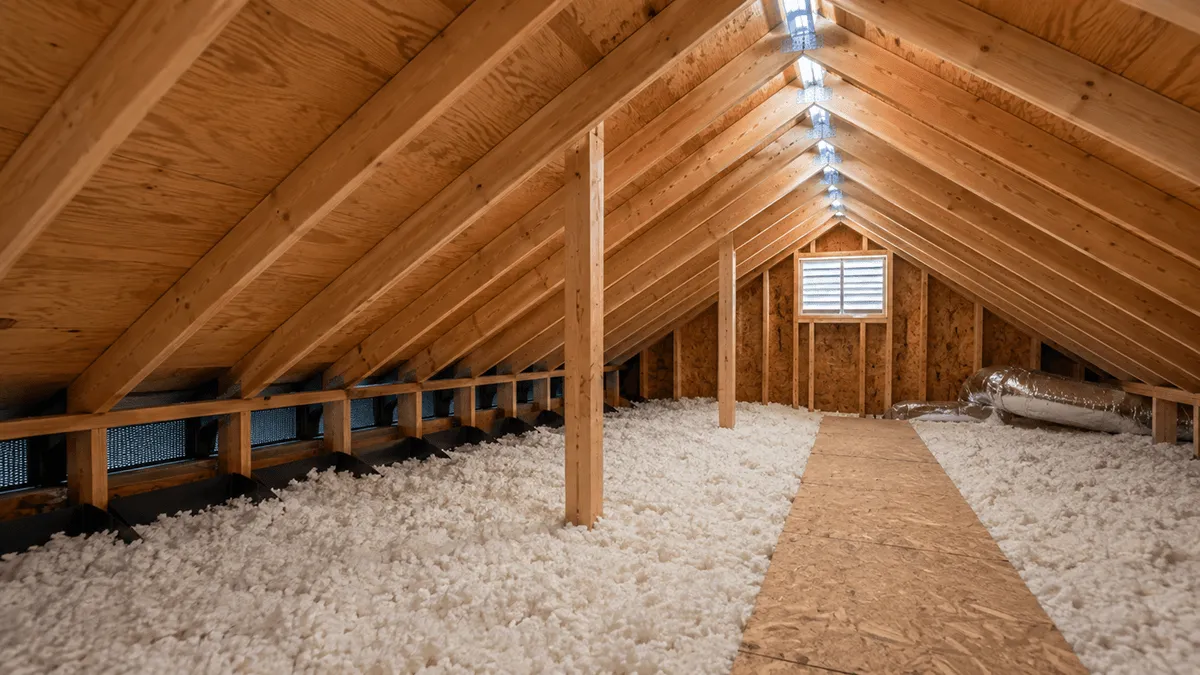
We also look at baffles, the small channels installed at the eaves to keep insulation from collapsing into the soffit vent opening. On older homes where insulation has been added or topped off over the years without baffles installed first, we frequently find the soffit vents are physically present but completely buried under loose fill insulation, which makes them useless even though they look fine from outside the house. This single detail, easy to overlook, is one of the most common ventilation problems we correct in Reading.
Myth vs Fact: Attic Ventilation
Myth: More insulation always fixes attic heat. Fact: Insulation slows heat transfer between the attic and living space, but it does not move hot, stale air out of the attic itself. Without proper ventilation, a heavily insulated attic can still trap extreme heat that eventually radiates through the ceiling.
Myth: A powered attic fan is always an upgrade. Fact: A fan without matching soffit intake can depressurize the attic and pull conditioned air from your living space instead of pulling in fresh outside air, sometimes increasing energy costs rather than reducing them.
Myth: Ridge vents alone are enough. Fact: A ridge vent needs a matching amount of intake airflow from soffit vents to function correctly. Exhaust without adequate intake creates uneven airflow and dead zones, especially at the far ends of longer roof runs.
Myth: Ventilation is a cosmetic upgrade, not a real cost issue. Fact: Poor ventilation contributes directly to higher summer cooling costs, winter ice dam risk, and premature shingle aging from trapped heat, all of which cost real money over time.
Common Mistakes Homeowners Make
The most common mistake is adding insulation without ever checking whether the existing ventilation still functions. Blown-in insulation installed without a baffle at the eaves can block soffit vents completely, cutting off intake airflow years after the original ventilation was installed correctly.
The second mistake is installing a powered fan as a first response to attic heat, without confirming soffit intake can support it. This is one of the more expensive mistakes to reverse, since it usually means adding an electrical fixture that then needs to be removed or reworked.
A third mistake worth mentioning is mixing ventilation types without checking whether they work against each other. A ridge vent paired with a powered gable fan, for example, can pull air in through the ridge vent instead of out, since the fan changes the pressure balance the ridge vent was designed around. Any change to one part of the ventilation system should be checked against the rest of it, not treated as an isolated upgrade.
How to Decide: Passive or Powered Ventilation?
If your attic has adequate, unobstructed soffit vents and a continuous ridge vent, passive ventilation is usually sufficient and requires no ongoing energy cost. If your roof design limits ridge vent length, or the attic space is unusually large relative to available soffit area, a properly sized powered solution paired with confirmed adequate intake can help, but this should be assessed by someone checking actual airflow, not assumed from the outside.
Local Context: Reading's Summer Heat and Older Housing Stock
Reading's mix of older homes, many built before modern ventilation standards were common, means soffit blockages from past renovations or added insulation are a frequent finding on our inspections. Combined with New England's humid summer stretches, an unbalanced attic can trap significant heat during exactly the months when cooling costs matter most, then trap moisture during the winter months when ice dam risk is highest. Checking both intake and exhaust together, rather than assuming one fixes the other, is the difference between a real fix and a half-measure.
Many of Reading's Cape and colonial-style homes were also built with relatively low-profile roof pitches, which naturally limits how much ridge length is available for exhaust venting compared to a steeper roof of the same footprint. That structural detail alone can explain why two similarly insulated homes in Reading perform very differently in summer heat, and it is one more reason a physical airflow check matters more than a general rule of thumb.
What to Do Next
If your upstairs rooms run hot in summer or you have noticed frost in the attic during winter, a real airflow check is the right next step before adding insulation or a fan. Ask about a free ventilation check with your next inspection, so you know whether the issue is intake, exhaust, or both. Our Roof Inspections process includes checking soffit and ridge airflow together, not just the shingles on top.
You can also visit us in Danvers, MA to talk through your attic setup in person.
Frequently Asked Questions
How do I know if my attic ventilation is unbalanced?
Signs include an attic that feels significantly hotter than outside air in summer, frost or condensation on the roof deck in winter, or a musty smell that developed over the years. A physical check of soffit and ridge vents, ideally from both inside the attic and outside on the roof, confirms whether intake and exhaust are actually matched.
Will fixing attic ventilation lower my summer energy bill?
Often, yes, particularly if trapped attic heat has been radiating into upstairs rooms and forcing your air conditioning to work harder. The savings depend on how imbalanced the current system is, but correcting a blocked soffit or mismatched vent ratio is one of the more cost-effective improvements available.
Can I add a ridge vent to an existing roof without replacing the whole roof?
Often, yes, if the roof structure allows for it and there is enough continuous ridge length. This is frequently done alongside a repair or partial reroofing project rather than requiring a full replacement on its own.
Does poor attic ventilation shorten my shingle's lifespan?
Yes. Trapped heat in the attic radiates upward into the shingles from underneath, accelerating the aging process beyond what normal sun exposure alone would cause. Manufacturers' shingle warranties often specify minimum ventilation requirements for exactly this reason.
Is it worth checking ventilation if I am not having any obvious problems?
It can be, especially in older Reading homes where a past renovation may have blocked soffit vents without anyone noticing. A quick check during a routine inspection costs little and can catch a slow-developing issue before it shows up as a high energy bill or an ice dam.
Can a recent attic or insulation project cause a new ventilation problem?
Yes, and this is more common than most homeowners expect. Adding or topping off insulation without installing baffles at the eaves can bury existing soffit vents completely, cutting off intake airflow that was working fine before the project. If a heat or moisture problem started shortly after an attic renovation, that timing is worth mentioning to whoever inspects it.

Gustavo Cardoso, President.