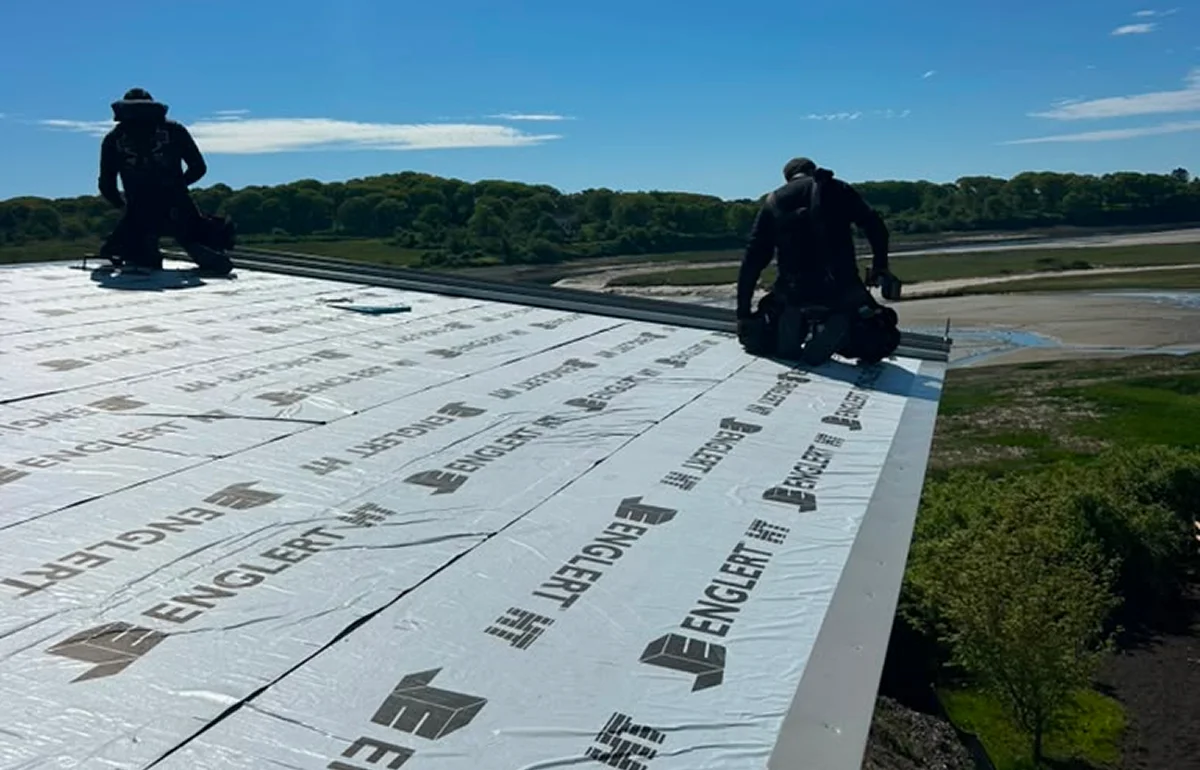
Commercial flat roofing on the North Shore takes more punishment than most property owners expect. Here is what EPDM, TPO, and modified bitumen each offer for Massachusetts buildings, and how to maintain them through New England winters.
Commercial flat roofing on the North Shore takes more punishment than most property owners expect. Massachusetts winters bring snow loads that stress low-slope membranes, freeze-thaw cycles that open up seams, and ice buildup at drains and parapet walls. If you manage a commercial building, multi-unit property, or retail space in the region, choosing the right membrane and maintaining it consistently is the decision that separates a 25-year roof from one that develops problems in five.
EPDM, TPO, and Modified Bitumen: Matching the Membrane to a Massachusetts Building
Three membrane types cover most flat roofs installed on commercial buildings across the North Shore: EPDM, TPO, and modified bitumen. Each performs differently in this climate, and each carries a different cost and lifespan profile worth understanding before you commit to a replacement contract.
EPDM (ethylene propylene diene monomer) is a black rubber membrane that has been the default choice for New England commercial flat roofs for decades. It stays flexible in sub-freezing temperatures, tolerates freeze-thaw cycling reliably, and typically lasts 25 to 30 years with proper maintenance. The black surface absorbs heat, which helps shed snow in winter but raises cooling costs in summer on buildings with significant load.
TPO (thermoplastic polyolefin) is a white reflective membrane. Its surface reduces summer heat gain and can lower cooling costs noticeably on large commercial footprints. Seams are heat-welded rather than taped, producing a strong bond when installed to spec. Lifespan runs 15 to 25 years in typical New England conditions, and the per-square-foot cost is modestly higher than EPDM.
Modified bitumen is an asphalt-based system installed in layers, either by torch, cold adhesive, or self-adhering sheet. It handles rooftop foot traffic well, which matters on buildings with rooftop mechanical equipment, and it works across varied slope conditions. Installation is more labor-intensive than EPDM or TPO, but modified bitumen has a long, proven track record on older Massachusetts commercial buildings where the substrate is uneven.
Winter Hill Roofing is a GenFlex-certified installer for commercial flat roofing systems, which means the membranes we install meet manufacturer specification and the work is backed with certified documentation.
Signs Your Commercial Flat Roof Needs Replacement, Not a Patch
Property managers often patch flat roofs until the patchwork itself becomes the problem. Knowing when a repair is the right call versus when replacement is the honest answer saves money over the life of a building.
A patch is appropriate when the membrane is otherwise intact, the damaged area is localized, the system is under 15 years old, and drainage is functioning correctly across the rest of the roof. Replacement is worth a serious conversation when any of the following shows up:
- Ponding water that remains 48 hours after rain, pointing to a drainage or structural deflection problem that a surface patch cannot fix.
- Membrane blistering or bubbling across more than a small area, which signals adhesion failure or moisture trapped beneath the surface.
- Multiple seam failures in a short period, indicating the membrane has reached the end of its serviceable life.
- Active leaks at multiple locations that have returned after prior repairs.
- A roof past 20 years old showing any combination of the conditions above.
A thorough commercial roof inspection documents all of these conditions before a replacement decision is made. Winter Hill Roofing provides written inspection reports with photos for every commercial assessment.
What New England Winter Does to Flat Roofs
The North Shore climate creates stresses on flat roofs that milder regions never face. Understanding them is part of choosing and maintaining the right system.
Snow load is the most straightforward concern: Massachusetts roofs are engineered to a minimum design load, but flat and low-slope roofs can accumulate ice and snow unevenly, especially when drainage is partially blocked. Uneven accumulation concentrates weight and stresses the membrane at the perimeter and drains.
Freeze-thaw cycling is more damaging over time. Water that enters a seam or through compromised flashing does not stay liquid in winter. It expands as it freezes, widening the opening and forcing a repair conversation every spring. Systems installed without proper seam overlap or without fully adhered perimeter edges are the first to fail when cycling starts.
Ice at drains and scuppers is a direct consequence of blocked drainage. When a drain freezes over, meltwater from the field of the roof has nowhere to go. It backs up, finds the lowest transition point, and works through any gap it can reach. Keeping drains clear in November and after every significant storm is not optional on a New England flat roof.
Parapet walls and flashings are where most commercial flat roof leaks originate. The transition from horizontal membrane to vertical wall is the most stress-prone joint on the roof, and it is also the area most often skipped in a budget patch job. A properly terminated and counter-flashed parapet is the difference between a tight roof and a chronic leak problem.
Preventative Maintenance Programs and Why They Pay for Themselves
A commercial flat roof that receives two inspections per year, with drains cleared and minor seam repairs addressed before they become failures, consistently lasts longer than one that is only attended to when a leak is already visible inside the building.
The math is straightforward. An active leak triggers emergency response costs, interior water damage remediation, possible tenant disruption, and a repair completed under pressure rather than under controlled conditions. A scheduled maintenance visit costs a fraction of any of those, and it gives the roofer a chance to catch a blister or lifted seam before it becomes a larger problem.
Winter Hill Roofing offers commercial preventative maintenance programs that include documented inspections each fall and spring, drain clearing, minor seam and flashing repairs, and a written condition report after each visit. For property managers overseeing multiple buildings, a single point of contact across the portfolio simplifies scheduling and keeps records organized year over year.
Choosing a Licensed Commercial Roofer in Massachusetts
Commercial flat roofing in Massachusetts requires a licensed contractor. Any roofer working on a commercial building must hold a Home Improvement Contractor (HIC) registration or a Construction Supervisor License (CSL), pull permits on qualifying jobs, and carry the insurance coverage required by state law.
Ask any contractor you are considering for their Massachusetts license numbers before work begins. A reputable commercial roofer will have this information ready immediately, will pull permits where required, and will provide full documentation at the close of a job. A contractor who discourages permitting or cannot produce license numbers on request is a significant liability on a commercial property.
Winter Hill Roofing holds Massachusetts HIC #204047 and CSL #CS-118689. We pull permits on every job that requires one, provide written contracts before work begins, communicate daily through each project, and clean the site at the end of every workday. For commercial flat roofing on the North Shore, call us at (978) 733-8671 for a free inspection and written assessment with no obligation.
Want our roofing tips to show up first when you search? Add us as a preferred source on Google.

Gustavo Cardoso, President.