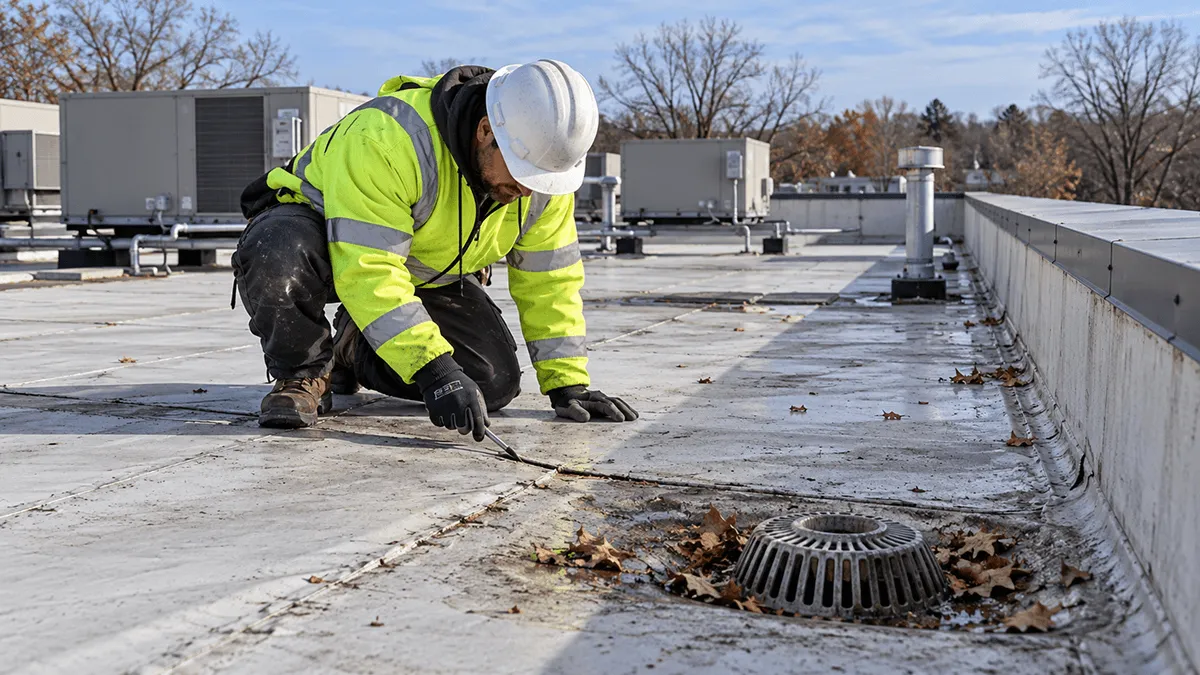
Flat and low-slope roofs carry the highest snow-load risk. Here are 5 signs commercial roofing in Danvers needs attention before winter.
Property managers often assume a flat commercial roof is either fine or obviously failing, with nothing in between. That's not accurate. Commercial roofing in Danvers tends to show warning signs well before a real problem develops, and catching them in late fall gives you a real window to act before winter's heaviest snow arrives.
Quick Answer: What Are the Warning Signs?
Watch for ponding water that doesn't drain within 48 hours, visible membrane cracking or blistering, sagging sections of the roof deck, rusted or damaged flashing around vents and equipment, and interior signs like ceiling stains or a musty smell near the roofline. Any one of these on its own is worth a professional look. Commercial roofing in Danvers with more than one of these signs present usually needs attention before the first heavy snow event of the season, not after.
What Property Managers Usually Notice First
Most property managers notice a problem indirectly, a tenant complaint about a ceiling stain, a slightly higher heating bill, or standing water visible from a nearby window after a storm. These indirect signs often get deprioritized since they're not causing an obvious emergency yet.
What often gets missed is that flat and low-slope roofs, the type most common on commercial and industrial buildings, carry meaningfully more structural risk under snow load than typical residential rooflines. According to the Massachusetts Emergency Management Agency, flat and low-pitched roofs are at the greatest risk of buckling under heavy snow and ice accumulation. Commercial roofing in Danvers that shows any of the five warning signs above deserves attention specifically because of this elevated risk category, not just general maintenance concern.
What a Roofing Contractor Looks For
On many commercial inspections, we see property managers focused on obvious leaks, which makes sense since that's what tenants report first. A roofer evaluates the whole membrane system. We check for ponding patterns that indicate a drainage issue rather than a one-time event, membrane seams for early separation, and flashing at every roof penetration, since commercial roofs typically have far more equipment penetrations than a residential roof.
What property managers often miss is that ponding water isn't just a nuisance, it's added weight sitting directly on the structure, and it accelerates membrane deterioration in that exact spot over time. A roof that's been ponding in the same location for multiple seasons is more vulnerable heading into a heavy snow winter than one with the same square footage but proper drainage.
Winter Hill Roofing handles Commercial Roofing projects throughout Danvers, including flat and low-slope systems on commercial and light-industrial buildings.
Common Mistakes Property Managers Make
The most common mistake is treating a flat roof as maintenance-free simply because there's no visible slope for water to run off dramatically. Flat and low-slope systems actually require more attention to drainage than pitched roofs, not less, since there's no natural gravity assist moving water away from vulnerable areas.
A second mistake is waiting for a tenant complaint before scheduling an inspection. By the time interior signs appear, the underlying membrane or drainage issue has often been developing for months, which usually means a larger repair than if it had been caught during a routine fall check.
A Danvers property manager described exactly this pattern after a tenant reported a ceiling stain in a commercial unit. What had looked like a minor cosmetic issue traced back to a ponding area that had been slowly degrading the membrane for at least two seasons. Addressing the drainage issue directly, rather than just patching the visible leak, resolved the underlying cause of the commercial roofing in Danvers' concern rather than just its symptom.
A related mistake is deferring maintenance because a building is leased and the roof feels like the landlord's problem rather than an urgent priority for whoever manages the site day to day. Lease terms vary, but regardless of who ultimately pays for a repair, a small, inexpensive fix caught early is almost always a better outcome for everyone involved than a larger repair or a tenant relocation caused by a failure that went unaddressed for too long.
Decision Guidance: Repair Now or Schedule for Spring?
If you're seeing active leaks, significant ponding, or visible membrane damage, address it before winter rather than waiting. Snow load adds weight to an already compromised roof structure, and the risk window for collapse concerns typically opens in December and runs through February. If your roof shows only minor, cosmetic wear with no drainage issues, a spring assessment may be reasonable, but that judgment call should come from a professional inspection rather than a guess from the ground.
One customer described a related flat-roof project this way: "They removed and replaced our flat rubber roof over six straight days even through a heat wave. We've since had several downpours and all is well." That kind of reliable, weather-tested outcome is exactly what a commercial property owner needs heading into a Massachusetts winter.
Local Weather Context: Why This Matters in Danvers This Winter
Massachusetts winters place real structural demands on flat and low-slope roofs specifically. NOAA's records for Boston Logan Airport show the 2014-2015 winter alone brought 110.6 inches of snow, a season during which Massachusetts saw dozens of documented roof collapses, concentrated heavily on flat and low-pitched commercial and industrial buildings. Danvers' commercial corridor near Liberty Tree Mall and Route 128 includes a significant share of exactly this roof type, which makes fall inspection timing especially relevant for local property owners and managers.
A specific snow depth that would cause a collapse cannot be stated as a universal figure, since collapse risk depends on a building's individual engineered load rating, roof condition, and existing structural wear. Rather than estimating a threshold here, any property showing warning signs should have its actual load capacity professionally assessed.
Older commercial buildings in Danvers, particularly those built before more recent structural codes took effect, sometimes carry lower engineered load ratings than newer construction nearby, even when they look structurally similar from the outside. This is part of why an assessment of your specific building matters more than a general rule of thumb about snow depth. Two buildings on the same block can have meaningfully different risk profiles depending on age, prior roof work, and how many membrane layers have accumulated over past repairs.
It's also worth building a simple maintenance record for your building's roof, even a basic log of past repairs, inspection dates, and any recurring problem areas. A property that changes management or ownership benefits from this kind of documentation, since a new manager stepping in without that history has no way to know whether a given warning sign is new or something that's been monitored and managed for years. That record also makes any future professional assessment faster and more accurate, since the contractor isn't starting from zero.
Ready for a Commercial Roof Assessment?
If your building shows any of the five warning signs above, a professional assessment now gives you real options before winter's heaviest snow arrives. You can also visit us in Danvers, MA to talk through what we'd check on your specific commercial roof. Get a free commercial roof snow-load assessment before winter.
Frequently Asked Questions
How much snow will actually cause a commercial roof to collapse?
There's no universal number, since collapse risk depends on your building's specific engineered load rating, roof age, and existing condition. A professional structural assessment is the only reliable way to know your building's actual capacity.
How often should commercial roofing in Danvers be inspected?
Twice a year is a reasonable baseline for most flat and low-slope commercial roofs, once in spring and again in fall before winter weather arrives. Buildings with a history of ponding or leaks may benefit from more frequent checks.
Is ponding water always a problem on a flat roof?
Not always immediately, but water that doesn't drain within about 48 hours after a rain event typically indicates a drainage issue worth addressing. Persistent ponding in the same spot adds ongoing structural weight and accelerates membrane wear.
Can commercial roofing in Danvers be repaired during winter, or does it have to wait?
Some repairs are possible in cold weather with the right materials and an experienced crew, but many membrane repairs work best above certain temperatures. Addressing known issues before winter reduces the chance of needing an emergency cold-weather repair.
What's the difference between a repair and a full commercial roof replacement?
Isolated issues, a section of damaged membrane or a single problem drain, usually mean a repair. Widespread ponding, multiple leak points, or a roof already near the end of its expected service life point toward considering a full replacement instead. A professional inspection is the clearest way to know which situation applies.
Does commercial roofing in Danvers cost more to maintain than residential roofing?
Costs vary significantly based on roof size, system type, and condition, so there's no single comparison that applies to every building. Flat and low-slope commercial systems generally require more frequent drainage checks than a typical residential pitched roof, which is part of why routine inspection matters.
Want our roofing tips to show up first when you search? Add us as a preferred source on Google.

Gustavo Cardoso, President.