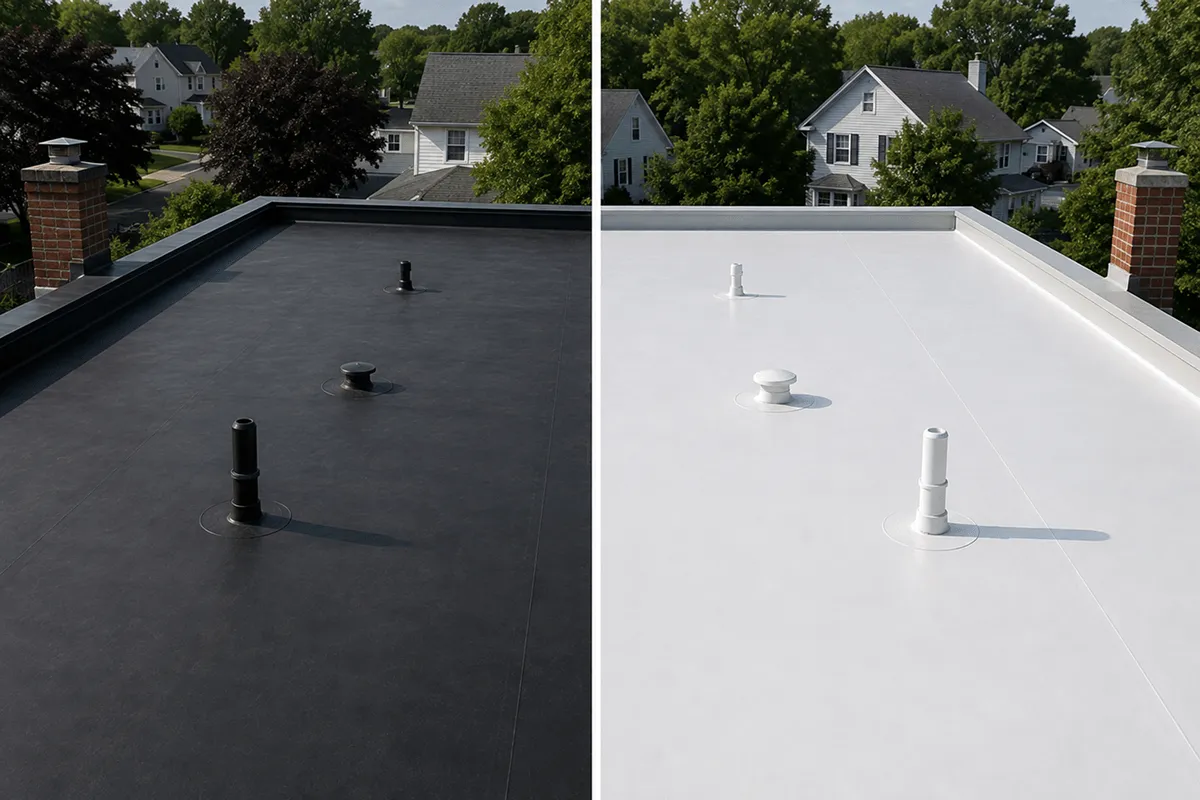
Comparing EPDM vs TPO roofing in Burlington for your office or industrial property? See how each performs in New England's climate.
EPDM vs TPO roofing in Burlington is one of the most common questions we get from property managers overseeing office and industrial buildings along the Route 128 corridor. Both are proven flat roof membrane systems, but they perform differently in New England's mix of cold winters and humid summers, which matters more here than in milder climates.
Which Is Better, EPDM or TPO, for a Burlington Commercial Roof?
EPDM vs TPO roofing in Burlington comes down mainly to climate priorities and building use. EPDM, a black rubber membrane, typically lasts 25 to 30 years and holds up exceptionally well through New England's freeze-thaw winters, staying flexible in cold temperatures where more rigid materials can crack. TPO, a white reflective membrane, typically lasts 15 to 25 years and reduces summer cooling costs significantly by reflecting solar heat instead of absorbing it. Neither is universally better. The right choice depends on your building's cooling needs, budget, and how long you plan to hold the property.
What Property Managers Usually Notice First
Most Burlington property managers first notice the age of their existing membrane when a routine inspection flags ponding water or a seam starting to lift. That is usually the trigger for the EPDM versus TPO conversation, especially on buildings originally roofed 20 or more years ago when EPDM was the dominant choice for nearly every flat commercial roof in the region.
The second thing they notice, once quotes come in, is that the two systems are closer in price than expected, and that the real cost difference shows up over the life of the roof rather than at installation. A slightly higher upfront cost for TPO can be offset by lower cooling bills over a decade, particularly on larger buildings with significant HVAC load.
A pattern we see often along Burlington's office corridor involves a property manager overseeing several buildings of similar age and construction, where one building runs a noticeably higher summer electric bill than the others despite similar square footage and tenant use. In more than one case, the difference traced back to an older, heat-absorbing EPDM membrane on the higher-cost building versus a lighter-colored surface on the others. That kind of side-by-side comparison across a portfolio is often the clearest real-world evidence for which membrane actually pays off on a specific site.
What a Roofing Contractor Looks For
On many commercial roof assessments we run in Burlington, the first thing we check is drainage, because ponding water is a structural and slope issue, not something either membrane type solves on its own. A roofer evaluates this by looking at how water moves across the roof after a rain event, checking for standing water 48 hours later, which points to a drainage problem regardless of which membrane sits on top.
What property managers often miss is that TPO's heat-welded seams create a notably stronger bond than EPDM's adhered or taped seams, which matters more on buildings with significant rooftop equipment, foot traffic, or frequent HVAC servicing. EPDM's simpler adhesive installation can mean lower labor costs, but the seams themselves are generally considered less robust under repeated mechanical stress.
We also check existing insulation and whether a full tear-off is needed versus a recover option. On buildings where the existing roof deck and insulation are still sound, a recover can significantly reduce project cost regardless of which membrane you choose, but that determination requires a physical inspection, not a guess from the parking lot.
Rooftop equipment placement gets a close look too. Buildings with multiple HVAC units, satellite dishes, or frequent maintenance foot traffic put repeated mechanical stress on the areas around each penetration point. On those roofs, we weigh TPO's stronger heat-welded seams more heavily in our recommendation, even when EPDM might otherwise be the lower-cost option, because seam failures around high-traffic equipment areas tend to be the first point of failure regardless of membrane age.
EPDM vs TPO: A Practical Comparison for Burlington
Lifespan: EPDM typically reaches 25 to 30 years, with some well-maintained systems exceeding that. TPO typically reaches 15 to 25 years, with modern formulations showing improved durability over older versions.
Energy efficiency: TPO's white surface reflects a large share of solar radiation, cutting cooling costs meaningfully in buildings with significant air conditioning load. EPDM's black surface absorbs heat, which can be a minor advantage for winter snow melt but adds to summer cooling costs.
Cold weather performance: EPDM's rubber composition stays flexible through New England's freeze-thaw cycles, resisting cracking better than many alternatives. TPO performs reasonably well in cold weather too, though EPDM's longer track record gives more confidence for buildings prioritizing winter durability above all else.
Seam strength: TPO's heat-welded seams are considerably stronger than EPDM's adhered seams, an advantage worth weighing for roofs with heavy equipment or frequent maintenance access.
Cost: Material costs are broadly similar, with EPDM sometimes slightly less per square foot. On larger roofs, TPO's faster heat-welded installation can offset its material cost, sometimes making it competitive or even cheaper than EPDM on bigger jobs.
Common Mistakes Property Managers Make
The most common mistake is choosing a membrane based on price alone without factoring in the building's cooling load. A building with substantial rooftop HVAC and high summer usage often saves more over time with TPO's reflectivity than the slightly lower EPDM material cost would suggest.
The second mistake is assuming ponding water is a membrane problem rather than a drainage or structural issue. Both EPDM and TPO tolerate standing water reasonably well in the short term, but chronic ponding indicates a slope or drainage problem that needs addressing regardless of which membrane sits on top.
A third mistake is treating a membrane decision as permanent regardless of a building's changing use. A warehouse converted to office space, for example, often sees a meaningful increase in HVAC load and occupancy, which shifts the cost-benefit calculation toward TPO's energy savings even if the original roof was specified as EPDM under the building's prior use. Reassessing the membrane choice at the point of a major re-roof, rather than defaulting to whatever was there before, is worth the extra conversation.
How to Decide Between EPDM and TPO
If your Burlington building has significant cooling demand and you plan to hold the property long term, TPO's energy savings often justify the modestly higher installation cost. If your priority is proven long-term durability through New England winters and your cooling load is more modest, EPDM remains a reliable, well-tested choice with a longer performance history in this climate.
Local Context: Burlington's Office and Industrial Roofs
Burlington's concentration of office parks and industrial buildings along Route 128 means flat, low-slope commercial roofs are the norm rather than the exception. Many of these buildings were roofed with EPDM during the material's peak adoption decades ago and are now approaching replacement age, making this exact comparison one of the most common conversations we have with property managers in town. Winter snow load and freeze-thaw cycling make membrane flexibility a real consideration here, not just a manufacturer's marketing point.
Burlington's building mix along the Route 128 corridor also tends to include larger footprint structures than neighboring residential towns, which changes the math on membrane choice. A larger roof area amplifies both TPO's potential energy savings and the labor efficiency of its heat-welded seam installation, which is part of why we see TPO increasingly specified on newer, larger commercial re-roofs in the area even as EPDM remains common on smaller buildings.
What to Do Next
If your commercial roof is approaching the end of its expected lifespan or showing signs of ponding or seam wear, the right next step is a physical assessment before choosing between membranes. Request a commercial roof assessment for your property, so the drainage, insulation condition, and cooling priorities are all factored into the recommendation. Our Commercial Roofing team evaluates both membrane options against your building's actual usage, not a one-size-fits-all default.
You can also visit us in Danvers, MA to discuss your property's roof history in person.
Frequently Asked Questions
Is TPO always more energy efficient than EPDM?
In most cases, yes, due to its reflective white surface reducing solar heat absorption, which typically lowers cooling costs in buildings with significant HVAC demand. The actual savings depend on your building's size, cooling load, and local energy rates, so the benefit is more pronounced on larger buildings than smaller ones.
Does EPDM handle New England winters better than TPO?
EPDM has a longer proven track record in cold climates, with some installations from decades ago still performing well, thanks to its flexible rubber composition. TPO also performs adequately in cold weather, but EPDM's track record gives more confidence for buildings prioritizing winter durability as the top factor.
Can I install a new membrane over my existing commercial roof?
Sometimes, if the existing roof deck and insulation are still structurally sound and moisture-free. This recover option can reduce project cost significantly compared to a full tear-off, but it requires a physical inspection to confirm the existing roof qualifies.
What should I do about storm damage to my commercial roof?
Document the damage with photos and get a written, itemized inspection report from a roofing contractor. We can help document conditions and provide that report, but we do not negotiate insurance settlements on your behalf, since that generally requires a licensed public adjuster under Massachusetts law.
How often should a commercial flat roof be inspected?
Twice a year is a common baseline, typically in spring and fall, plus an additional check after any major storm event. Regular inspections catch ponding water, seam separation, or membrane wear early, before they turn into a larger, more expensive repair.
Does a building's use affect which membrane makes more sense?
Yes. A building with heavy rooftop HVAC use, frequent maintenance foot traffic, or a recent shift from warehouse to office space often benefits more from TPO's energy efficiency and stronger seams than the same building would have a decade earlier under lighter use. It is worth reassessing the membrane choice whenever a building's use changes significantly, rather than automatically matching whatever was installed originally.

Gustavo Cardoso, President.