Ice dams are the quiet winter threat to North Shore roofs. They build slowly, then push water straight through the ceiling. Here is how they form and how to stop them before January locks in.
Every winter, homeowners from Andover to Wakefield call us about the same problem: water coming through a ceiling in February, under a roof that looked fine in October. The cause is almost always an ice dam. They are preventable, but the time to prevent them is in the fall. Once January locks in, your options shrink fast.
What an ice dam actually is
An ice dam is a ridge of ice that forms along the edge of your roof. It starts with heat escaping your living space into the attic. That heat warms the upper roof deck, and the snow sitting on it melts. The meltwater runs down the slope until it reaches the eaves, the overhang that extends past your exterior walls. The eaves sit over open air instead of heated rooms, so they stay cold. The water refreezes there, and a band of ice starts to build.
The ice itself is not the real problem. The problem is the meltwater that keeps arriving behind it. With nowhere to drain, it pools against the dam and rises until it works under the shingles. Shingles are built to shed water moving downhill, not to hold back water that sits and climbs. Once it reaches the roof deck, it finds nail holes and seams. That is when you get stained ceilings, soaked insulation, and damaged walls.
Why North Shore homes get hit hard
Our winters do exactly what ice dams need. Freeze-thaw cycles, heavy snowfall, and back-to-back coastal storms keep snow on roofs for weeks, melting by day and refreezing by night. The housing stock makes it worse. The North Shore is full of older colonials, capes, and Victorians with attics insulated to the standards of a different era. Many have little or no soffit ventilation, plus complex rooflines with dormers and valleys where snow and ice collect.
If thick icicles hang off your gutters every winter, or you can see a band of ice at the roof edge while the upper slopes are bare, your house is telling you something. Heat is escaping, snow is melting, and your eaves are doing the refreezing.
The warning signs to watch for
Most ice dam damage shows itself weeks before the ceiling stains appear, but the early signs are easy to write off as a normal New England winter. They are not normal. Each one points to heat loss or trapped moisture, and both feed the same problem.
- Long icicles hanging from the gutters and roof edge, thick enough to reach the ground.
- A solid band of ice along the eaves while the rest of the roof has melted clear.
- Water stains on upstairs ceilings or at the top of exterior walls.
- Damp or musty smells in the attic, or frost on the underside of the roof deck on a cold morning.
- Matted or dark-stained attic insulation, which usually means it has been wet more than once.
Prevention is a system, not a single fix
Three layers, working together, keep ice dams from forming and keep water out when they form anyway.
- Air sealing and insulation. A cold attic is a healthy attic. The less heat escapes into the attic, the less snow melts on the roof above it. This is the root-cause fix.
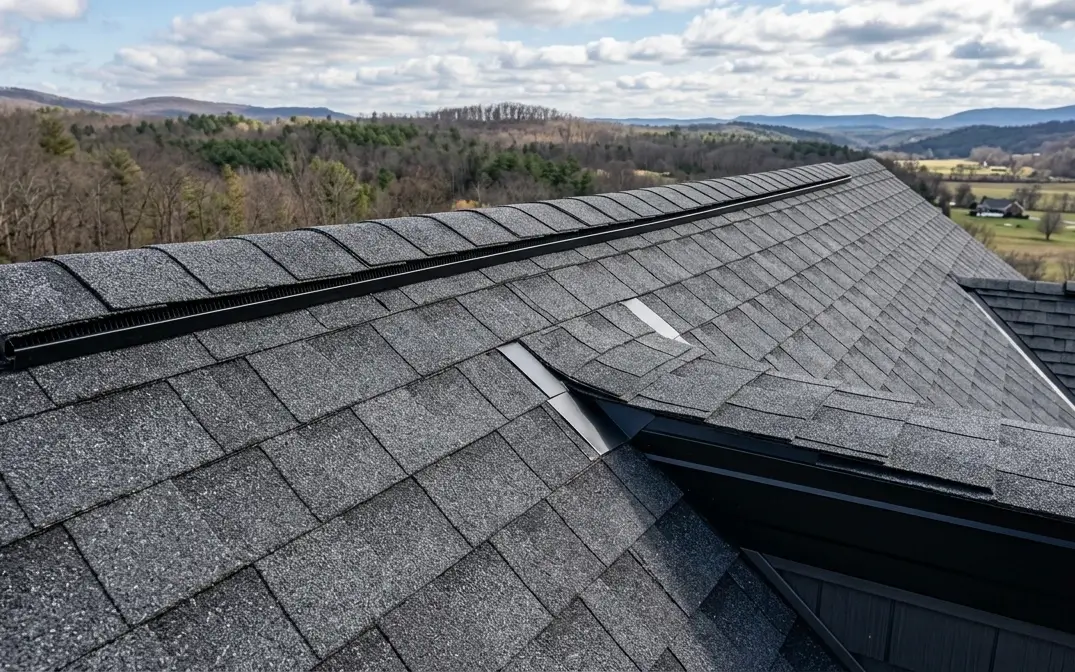
- Balanced attic ventilation. Intake vents at the soffit and exhaust at the ridge keep air moving, so the roof deck stays close to the outdoor temperature and snow melts evenly instead of refreezing at the eaves.
- Ice and water shield. A self-sealing membrane installed at the eaves and in the valleys. If meltwater does get past the shingles, the membrane stops it before it reaches the deck.
The first two reduce how much ice forms. The third protects you when some forms anyway, because in a hard New England winter, some will.
What we include on every replacement
Ice dam protection should not be sold as an upgrade. On every roof replacement, Winter Hill installs it as part of the system:
- Full tear-off of the old roof, so we can inspect the decking underneath.
- Ice and water shield at the eaves and in the valleys.
- Synthetic underlayment across the rest of the deck.
- Architectural shingles or your chosen material, installed to manufacturer spec.
- Balanced attic ventilation matched to the roof.
- Permit and dumpster handled for you.
As a GAF Master Elite contractor, we install complete systems that qualify for the strongest manufacturer warranties available. Ventilation done right is part of what keeps those warranties valid.
When to call
Call in the fall if you can. Most residential roof replacements are completed in one to three days, and autumn scheduling is far easier than emergency work in February. Call sooner if you are already seeing the warning signs: heavy icicles every winter, water stains on ceilings or at the top of exterior walls, or frost on the underside of the roof deck in the attic.
If an ice dam has already formed, do not climb up and chip at it. Hacking at ice destroys shingles, and roof work over ice is how people get hurt. Call (978) 704-3039 instead. We will inspect the roof for free, document what we find with photos, and give you a written assessment with an honest answer about what your roof actually needs before winter does its worst.
What not to do when ice builds up
When water starts showing inside, the instinct is to attack the ice. Most popular fixes do more harm than good, and a few are genuinely dangerous.
- Do not chip, hammer, or pick at the ice. You will gouge shingles and strip the granules that protect them.
- Do not climb onto an icy roof. Frozen shingles are slick, and a fall is far worse than a stained ceiling.
- Skip the rock salt and ice-melt tablets on the roof. They stain shingles and corrode flashing and gutters.
Clearing the lower few feet of snow with a roof rake from the ground is the one move that is generally safe, and it takes pressure off the eaves. Everything else can wait for the weather to break and a professional repair.
Why we keep coming back to ventilation
Ice dams look like a shingle problem, but they almost always start below the roof. A deck that runs warmer than the outside air melts snow unevenly, and uneven melt is what feeds the dam at the eaves. Balanced ventilation keeps the whole deck close to the outdoor temperature: cold air enters low at the soffits, picks up heat, and leaves high at the ridge. Blocked soffits buried under old insulation break that loop, so on a full replacement we make sure the path stays clear and size the system to the roof.
Budget should not be the reason a homeowner waits until the ceiling is already stained, so Winter Hill offers financing through Hearth. You can spread the cost over monthly payments and get the work done before the season turns, and we walk you through the options during the estimate with no pressure either way.
Winter Hill Roofing has been a family-owned, GAF Master Elite contractor based in Danvers since 2014, serving homeowners across Boston's North Shore. We are fully licensed in Massachusetts under HIC #204047 and install slate, metal, and asphalt systems built for our winters. If ice dams have been a yearly headache, call (978) 704-3039 and we will give you a straight answer about what your roof needs before January locks in.

Gustavo Cardoso, President.