Roof replacement cost in Danvers is up in 2026. See 7 practical ways to manage the budget without cutting corners on materials or safety.
Roof replacement cost in Danvers has climbed noticeably over the past two years, following a national trend driven by material and tariff pressure. That does not mean homeowners are stuck paying full price with no options. Here are seven practical ways to manage the budget without cutting corners on the parts of the job that actually protect your home.
What Is Driving Up Roof Replacement Cost in Danvers?
Roof replacement cost in Danvers has increased largely because of material pricing pressure across the industry, with national data showing average residential roof replacement costs roughly a third higher in 2025 than the 2021 to 2024 average, even as overall storm-related claim volume dropped. Labor availability and permit timelines add smaller, more local pressure on top of that. The good news is that several of the biggest cost levers are still within a homeowner's control.
What Homeowners Usually Notice First
Most Danvers homeowners notice the sticker shock first, often when comparing a new quote to what a neighbor paid a few years ago for a similar job. The gap can be a few thousand dollars even on a comparable roof, and it is rarely due to one contractor overcharging. It usually reflects real material cost increases across the entire industry.
The second thing homeowners notice, once they start collecting quotes, is how differently contractors present pricing. Some give a single flat number. Others break out labor, materials, permits, and disposal separately. That difference in transparency often says more about the contractor than the price itself.
A pattern we see often in Danvers is a homeowner who collects three quotes, finds one significantly lower than the other two, and assumes they found a bargain. In our experience, that lower number is frequently missing a line item, most often deck repair contingency or dumpster and disposal fees, that gets added back in once the crew is already on the roof. Asking every contractor the same specific question, such as how they handle unexpected rot found during tear-off, is one of the fastest ways to compare quotes honestly.
What a Roofing Contractor Looks For
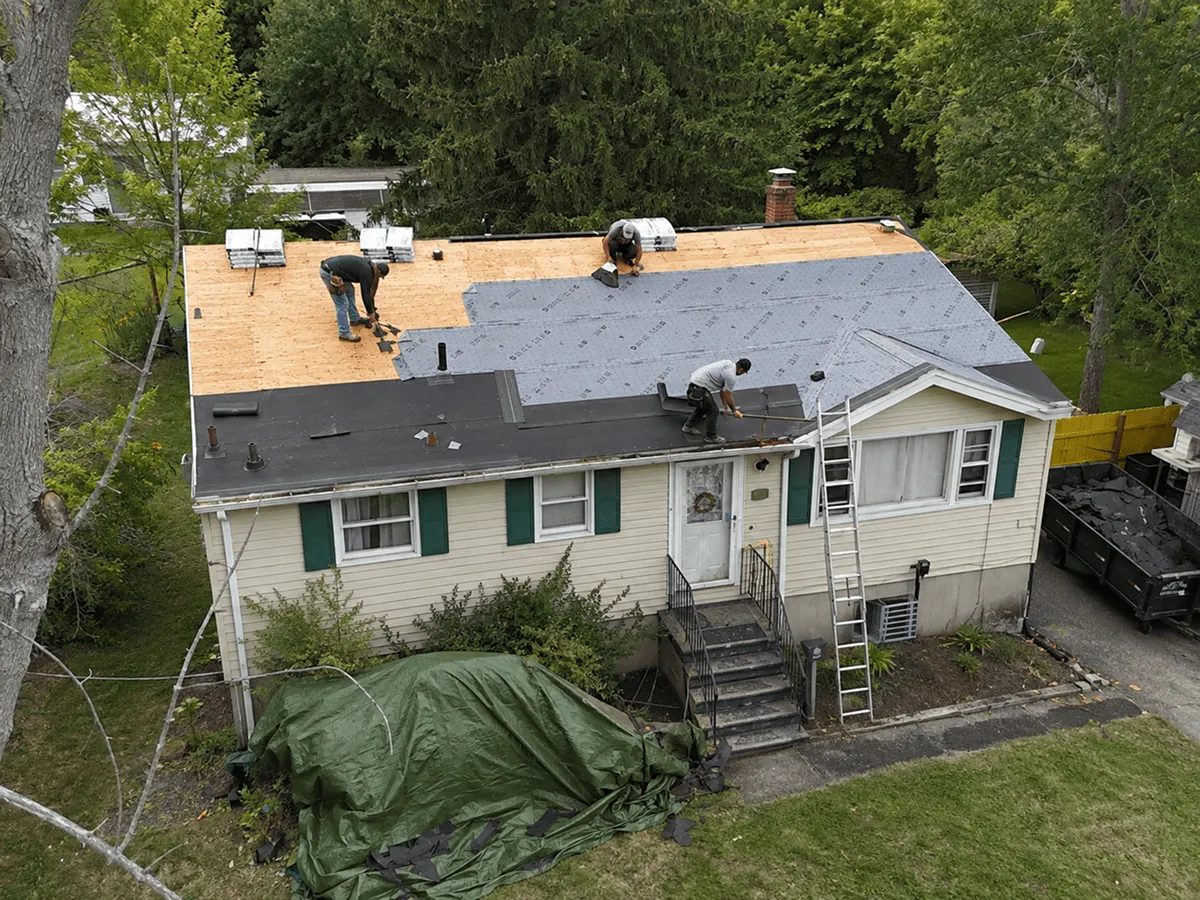
On many estimates we prepare in Danvers, the biggest cost variable is not the shingle brand, it is the roof deck condition underneath. A roofer evaluates this by checking for soft spots, rot, or old skip sheathing during the initial inspection, because deck repairs added mid-project cost far more than the same repairs identified and quoted upfront. What homeowners often miss is that a suspiciously low bid sometimes means the contractor is not accounting for likely deck repairs at all, and adds them later as a surprise change order.
We also look closely at how many layers of existing shingles are already on the roof. Massachusetts building code generally limits roofs to two layers before a full tear-off is required, and removing an old layer adds real labor and disposal cost that a homeowner may not expect if a previous roof was installed as a simple overlay years ago. Flagging this during the estimate, rather than discovering it once the crew starts stripping the roof, keeps the final invoice matching the original quote.
Here are seven practical ways we see homeowners manage cost responsibly:
1. Get a written, itemized quote, not a single number. A breakdown of labor, materials, permits, and disposal lets you see exactly where your money is going and compare quotes apples to apples.
2. Time the project outside peak season if your roof allows it. Late fall and winter scheduling, when contractor demand is lower, sometimes comes with more flexible pricing than the height of summer.
3. Ask about mid-tier architectural shingles instead of premium designer lines. The jump from a standard three-tab shingle to a solid architectural shingle matters for durability. The jump from a good architectural shingle to a premium designer style is often more about appearance than performance.
4. Bundle related work into one job. Combining a roof replacement with gutter replacement or minor siding repair in a single mobilization often costs less than scheduling them as separate projects months apart.
5. Ask about financing rather than delaying necessary work. A roof that is actively failing tends to cost more the longer repairs are deferred, so a manageable monthly payment can be less expensive long-term than waiting for cash savings while damage spreads.
6. Confirm your HIC registration and get multiple quotes. Massachusetts law caps deposits at one-third of the total contract price for home improvement projects. A contractor asking for more upfront is a red flag worth walking away from, regardless of price.
7. Never treat a deductible waiver as a discount. Any contractor offering to waive or absorb your insurance deductible is asking you to participate in insurance fraud under Massachusetts law. It is not a legitimate cost-saving strategy, even when it is framed as one.
Common Mistakes Homeowners Make
The most common mistake is choosing the lowest bid without checking what it excludes. A quote that seems significantly cheaper than the others often skips deck repair contingencies, permit fees, or disposal costs that show up later as change orders.
The second mistake is assuming financing is only for homeowners who cannot afford the job outright. Spreading a roof replacement cost over a fixed monthly payment, through a program like Hearth, is a legitimate budgeting tool many homeowners use even when they could pay cash, simply to preserve savings for other priorities.
A third, less obvious mistake is postponing a needed replacement for one more season to save money, only to end up paying for emergency repairs after a leak develops. In our experience, a homeowner who delays a full replacement by a year often spends more overall once emergency patchwork, interior water damage, and the eventual replacement are all added together than if the original project had simply moved forward on schedule.
How to Decide: Repair, Partial Replacement, or Full Replacement?
If less than a third of the roof shows damage and the rest is under 12 years old, a targeted repair is often the more cost-effective route. If the roof is nearing the end of its expected lifespan across most slopes, a full replacement, even at today's higher material costs, usually avoids paying for a repair now and a full replacement again within a few years.
Local Context: 2026 Material Costs and Danvers Timing
National data shows average residential roof replacement reached roughly $17,631 in 2025, about a third above the 2021 to 2024 average, driven largely by material and tariff-related cost increases rather than a jump in storm damage. Danvers homeowners are seeing this reflected in local quotes, which makes getting a clear, itemized estimate more valuable than ever, since it is the only way to see exactly which cost increases are unavoidable and which parts of the job still have flexibility.
Danvers' housing stock, a mix of mid-century capes and newer construction, means project costs vary more from house to house here than in towns with more uniform architecture. A steep, dormer-heavy roofline costs meaningfully more to replace than a simple gable roof of the same square footage, which is part of why two neighbors on the same street can receive quotes thousands of dollars apart for roofs that look similar from the street.
What to Do Next
If you are budgeting for a roof replacement and want to understand exactly where your money is going, start with a written, itemized quote rather than a verbal number. Get an itemized, written quote, no pressure, no hidden fees, so you can compare it honestly against other estimates. Our Roof Replacement process includes a full cost breakdown and a conversation about financing options if it helps the timeline work better for your budget.
You can also visit us in Danvers, MA to talk through your specific roof and get a written estimate in person.
Frequently Asked Questions
Why did my roof replacement quote come in higher than a neighbor's from a few years ago?
Material costs have risen substantially industry-wide, with national data showing average roof replacement costs about a third higher in 2025 than the 2021 to 2024 average. A gap between your quote and an older one is more likely tied to broad material pricing trends than anything specific to your roof or contractor.
Is financing a roof replacement a bad financial decision?
Not necessarily. Financing through a program like Hearth lets you spread the cost over manageable monthly payments instead of depleting savings or delaying necessary work, which often costs more later as damage spreads. It is worth comparing the total financed cost against the cost of waiting.
Can a contractor waive my insurance deductible to lower my cost?
No, legally. Waiving or discounting a deductible typically requires submitting a false invoice to your insurer, which is insurance fraud under Massachusetts law. Any contractor offering this should be treated as a serious red flag, not a discount.
What's the biggest hidden cost in a roof replacement?
Deck repair, most often. If the roof sheathing underneath the shingles has rot or soft spots, that repair gets added to the project, sometimes as a surprise if the original quote did not account for it. Asking your contractor directly how they handle unexpected deck repairs before signing avoids this surprise.
Should I choose the cheapest quote if the materials are the same?
Compare what each quote actually includes first. Two quotes listing the same shingle brand can still differ significantly in underlayment quality, ventilation work, deck repair allowances, and warranty terms. The cheapest number on paper sometimes means less coverage in one of those areas.
Does roof shape affect the total replacement cost?
Yes, significantly. A roof with multiple dormers, valleys, and steep pitches takes longer to install and uses more flashing and underlayment than a simple gable roof of the same square footage. Two homes with similar total roof area can still see a noticeably different price if one has a far more complex roofline.
Gustavo Cardoso, President.