Learn to spot squirrel damage to roof in South Hamilton before it turns into a leak. Six warning signs and what a roofer checks on inspection.
September and October bring the sharpest jump in calls we get for squirrel damage to roof in South Hamilton, right as acorns start dropping and squirrels look for dry, hidden places to stash their winter food supply. A lifted shingle tab or a small gap at the fascia is often the first sign. Left alone through fall, that small opening usually turns into a much bigger repair by the time the ground freezes.
What Does Squirrel Damage to Roof in South Hamilton Look Like?
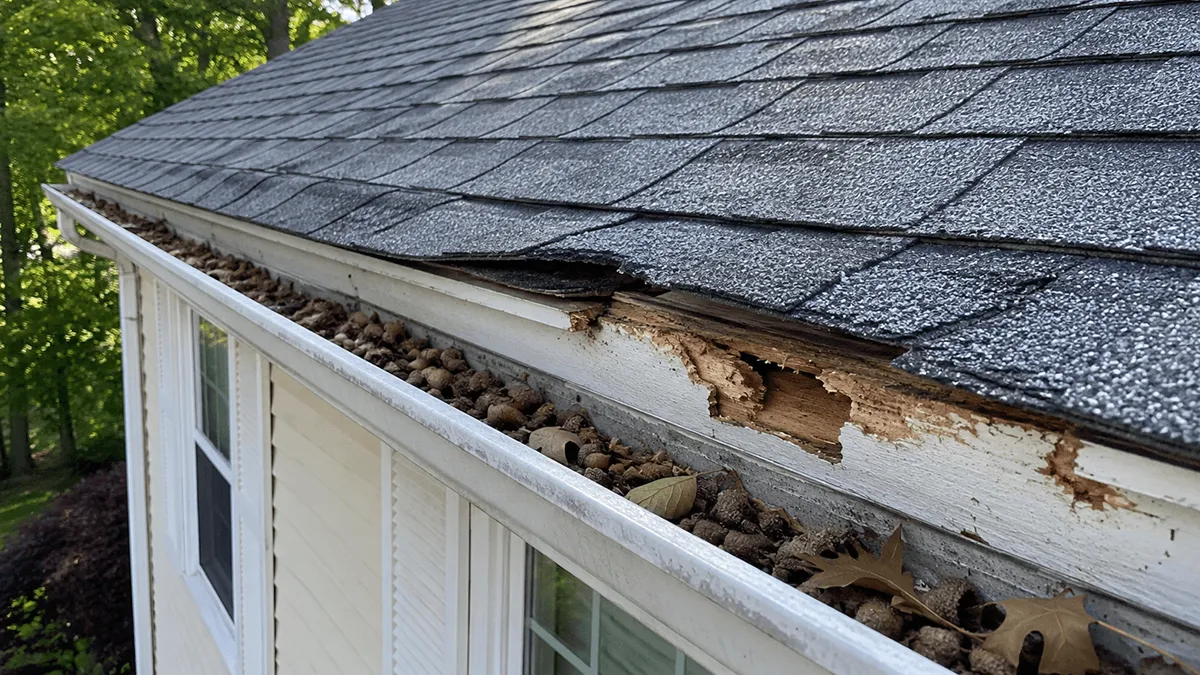
Squirrel damage to roof in South Hamilton usually starts small: a shingle tab pried up at the corner, a soffit gap chewed slightly wider, or acorn shells and debris tucked into a gutter section near a tree line. The animal is not trying to get inside your living space at first. It is looking for a dry cavity to cache food or, later in the season, to den for winter. Once an entry point exists, the damage tends to grow quickly as the gap gets used and widened repeatedly.
What Homeowners Usually Notice First
Most South Hamilton homeowners notice a sound before they notice damage: scratching or scurrying near the roofline, often heard from an upstairs bedroom or attic space, especially around dawn and dusk when squirrels are most active. It is easy to assume it is a tree branch brushing the roof, until the same sound repeats for several days running.
The second thing homeowners notice, once they finally look closer, is a shingle tab that seems slightly lifted at one corner, with small debris tucked underneath. On wooded lots near South Hamilton's conservation land and larger tree-covered properties, that debris is very often acorn shells, sometimes packed in surprisingly dense piles just under the shingle edge. A few homeowners also notice fresh gnaw marks on fascia boards, usually near a corner where two roof planes meet, since squirrels favor edges and seams they can grip while chewing.
A scenario we see often in South Hamilton involves a homeowner who hears activity in the attic for two or three weeks, assumes it will pass once the weather cools, and then discovers during a fall gutter cleaning that an entire section of fascia has been chewed through. By that point, what started as a simple exclusion and small repair has grown into a larger fascia replacement, because the opening had been in daily use long enough for more than one squirrel to widen it.
What a Roofing Contractor Looks For
On many roof inspections we run in South Hamilton during acorn season, the visible shingle damage is only the entry point, not the full story. A roofer evaluates this by tracing where the gap actually leads, since a chewed opening at the fascia often connects directly to the attic space, not just a shallow pocket under the shingle. We check whether the opening shows fresh gnaw marks, which suggests active use, or whether it looks old and undisturbed, which changes the urgency of the repair.
What homeowners often miss is that a roofer's job here is different from an animal removal job. We are not licensed to trap or relocate wildlife. In Massachusetts, removing nuisance wildlife like gray or red squirrels legally requires either a private landowner acting within narrow limits or a licensed Problem Animal Control agent through MassWildlife, and relocating a trapped animal to a new location is against state law regardless of who does it. What we do is identify the damage, confirm whether an animal is currently active in the space, and coordinate the repair and sealing work around a PAC agent's exclusion timeline if removal is needed first.
We also check insulation condition once we can see into the attic space near the entry point. Squirrels nesting in insulation compress and soil it, which reduces its effectiveness well beyond the immediate chewed area. A roofer evaluates whether insulation replacement needs to be part of the repair scope, not just the exterior fascia and shingle work, since leaving contaminated insulation in place undermines the whole point of sealing the entry.
Something homeowners rarely think to ask about is timing relative to occupancy. If a squirrel is actively denning in the space when we arrive, sealing the entry point immediately traps the animal inside, which creates a bigger problem than the one you started with. A roofer evaluates activity signs first, fresh droppings, matted insulation, or direct sightings, before recommending whether exclusion should happen now or after coordinating with a PAC agent for a one-way door setup that lets the animal leave without letting it back in.
Common Mistakes Homeowners Make
The most common mistake is sealing the entry point before confirming the space is empty. A homeowner who patches the hole themselves on a Saturday afternoon, without checking for an active occupant, sometimes traps an animal inside, which usually leads to a much worse smell and a bigger repair a week or two later.
The second mistake is assuming a small chewed gap will stay small. Squirrels are persistent, and an opening that goes unaddressed through fall often gets reused and widened by the same animal or a different one before winter sets in, since the sheltered, dry space becomes more attractive as outdoor temperatures drop.
The third mistake is treating this purely as a pest control problem and skipping the roof inspection afterward. Even once an animal is excluded and the hole is sealed, the underlying roof damage, chewed fascia, lifted shingles, or compromised soffit, still needs proper repair, or the same weak point will attract wildlife again next season. Homeowners who only address the animal, without repairing what let it in, tend to see squirrel damage to roof sections in South Hamilton return within a year or two.
How to Decide: Repair Only, or Repair Plus Removal?
If you hear activity in the attic or see fresh gnaw marks with debris still accumulating, assume an animal is currently using the space and start with a wildlife professional before sealing anything. If the damage looks old, with no fresh activity and no sounds for at least a week or two, a roof repair alone may be sufficient, though it is still worth a full inspection to confirm nothing is denning nearby out of sight.
A useful rule of thumb for South Hamilton's wooded properties: if the damage is near a large mature tree with branches close to the roofline, plan for both trimming the branch and repairing the roof, since an easy jump point from tree to roof is often what invited the animal in the first place.
Local Context: Why South Hamilton Sees This So Often
South Hamilton's mix of large wooded lots, mature oak trees, and properties bordering conservation land creates ideal conditions for exactly this problem every fall. Acorn drop typically peaks in September and October in this part of Essex County, and squirrels respond by aggressively seeking dry, sheltered cache sites, with roof edges, soffits, and fascia gaps being some of the most convenient options available on a typical suburban home.
This pattern is well documented by MassWildlife, which notes that squirrel activity around structures increases sharply during fall caching season and again in late winter during denning and birthing months. Homes closer to mature tree cover, common throughout South Hamilton's more wooded neighborhoods, tend to see squirrel damage to roof sections show up earlier and more persistently than homes in more open, cleared areas of town.
What to Do Next
If you are hearing activity near the roofline or noticing chewed trim and shingle damage, the safest next step is a real inspection before deciding whether you need a repair, an exclusion, or both. See chew marks or shingle lift? Schedule a free inspection, so you know exactly what is happening before the gap gets any bigger heading into winter. Our Roof Repair team checks fascia, soffit, insulation, and shingle condition together, and can point you toward a licensed PAC agent first if an animal is still active in the space.
You can also visit us in Danvers, MA to bring photos of the damage and talk through next steps in person.
Frequently Asked Questions
Can I remove a squirrel from my attic myself?
You can seal entry points once the space is confirmed empty, but trapping and relocating a squirrel yourself runs into Massachusetts law, since relocating wildlife is illegal regardless of who does it. If an animal is actively denning in the space, a licensed Problem Animal Control agent through MassWildlife is the legal path to safe removal before any repair work seals the entry.
Will homeowners insurance cover squirrel damage to my roof?
Usually not. Most standard homeowners policies treat wildlife damage as a maintenance issue rather than a covered peril, though coverage details vary by carrier and specific policy language. Confirm directly with your insurance agent before assuming any part of the repair is covered, since we cannot guarantee what your policy includes.
How do I know if a squirrel is still in the attic or already gone?
Listen for activity at dawn and dusk, since squirrels are most active during those windows, and look for fresh droppings or newly disturbed insulation near the entry point. If there has been no sound or new debris for at least a week, the space is more likely empty, though a physical inspection is the only way to confirm it with confidence.
Why do squirrels target roofs more in the fall than other seasons?
Fall lines up with peak acorn drop, when squirrels are actively caching food for winter and looking for dry, sheltered storage spots. Roof edges, soffits, and fascia gaps offer exactly that kind of protected space, which is why squirrel damage to roof sections in South Hamilton climbs sharply every September and October.
What's the difference between squirrel damage and woodpecker damage on a roof?
Squirrel damage usually shows up as a lifted or torn shingle tab with debris, often acorns, stuffed underneath, along with chewed fascia edges. Woodpecker damage tends to be small, round, clustered holes from repeated pecking, usually without the food debris squirrels leave behind. If you see both types of damage on the same roof, it is common for two different animals to be involved.
Gustavo Cardoso, President.