Hearing pecking at odd hours? Learn what woodpecker damage on roof areas in Middleton looks like and what a roofer checks before repairs.
Woodpecker damage on the roof in Middleton usually starts as a rhythmic tapping sound near the eaves or a chimney chase, easy to dismiss until small holes or lifted shingle tabs show up during a closer look. Middleton's wooded lots make this one of the more common calls we get every spring, and the fix depends entirely on why the bird is drilling in the first place, not just where.
What Does Woodpecker Damage on the Roof in Middleton Actually Look Like?
Woodpecker damage on the roof in Middleton typically appears as small, round holes clustered in one area, most often near roof edges, fascia boards, or cedar-style trim, sometimes paired with shingle tabs that look lifted or pecked loose. It rarely spreads evenly across the whole roof. Instead, it concentrates wherever the bird has found insects, a resonant surface for drumming, or a good nesting cavity. Left alone, the holes let moisture in behind the trim and shingles, which is the real long-term concern.
What Homeowners Usually Notice First
Most Middleton homeowners notice the sound before they ever spot the damage. It is a fast, rhythmic knocking, often right at sunrise, sometimes lasting only a few seconds at a time but repeating for days or weeks. It is easy to assume it is just a bird being a bird until someone finally grabs a ladder and finds small holes clustered around one corner of the roofline.
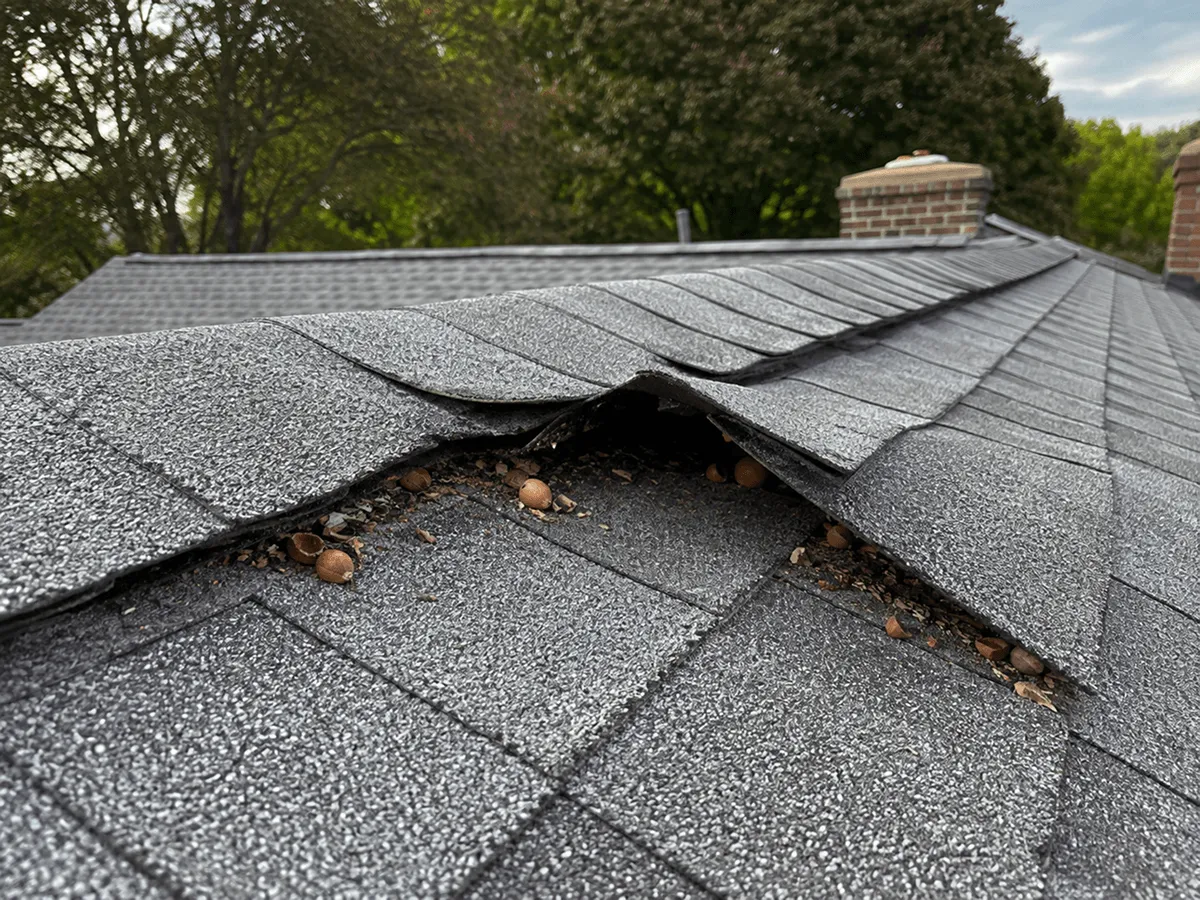
The second thing homeowners notice, usually later, is a lifted shingle tab nearby with debris tucked underneath it. On wooded lots across Middleton, that debris is very often acorns. Squirrels and woodpeckers frequently target the same weak points on a roof from different directions, one drilling and one wedging shingles up to stash food, and homeowners sometimes assume it is one problem when it is really two.
A scenario we see often in Middleton involves a homeowner on a wooded cul-de-sac who first notices the tapping in early May, assumes it will stop on its own once nesting season passes, and calls us in July after finding a soft spot in the fascia board. In that situation the deterrent installation is still straightforward, but the fascia repair adds cost that could have been avoided with an earlier call. Timing matters more than most homeowners expect.
What a Roofing Contractor Looks For
On many roof inspections we run in Middleton, the first thing we check is whether the damage pattern points to feeding, drumming, or nesting, because each one calls for a different response. A roofer evaluates this by looking at hole size, depth, and location. Small, shallow holes clustered near trim usually mean the bird is drilling for carpenter ants or bees living in the wood, which means the pest problem needs solving first or the bird will keep coming back to the same spot no matter what deterrent goes up.
What homeowners often miss is that woodpeckers are federally protected under the Migratory Bird Treaty Act, which means lethal control is not an option without a specific federal permit. Every legitimate fix relies on non-lethal deterrents: reflective tape or spinners, bird netting stretched over the affected area, or hard, smooth panels installed where the drumming is loudest. We often install netting angled from the gutter line back to the siding below a damaged section, since that physically blocks the bird without harming it.
We also check the roof deck itself once the surface holes are addressed. A hole that has gone unrepaired for a season or two often means water has already reached the sheathing underneath, even if the shingle above looks mostly intact. That is the part of the job homeowners cannot assess from the ground, and it is why we always recommend a real inspection rather than just patching the visible hole.
Beyond the deck, we also look at whether the drumming spot is a metal vent cap, a hollow fascia section, or a chimney cap, since these hollow, resonant surfaces attract territorial drumming even when there is no food source involved at all. A bird drumming on a metal roof vent for attention is a completely different problem than one feeding on insect larvae in rotted trim, and treating them the same way rarely solves either one.
Common Mistakes Homeowners Make
The most common mistake is patching the hole without addressing why the bird chose that spot. If carpenter ants or bees are living in the wood underneath, the woodpecker will likely return to the same general area even after a repair, because the food source is still there.
The second mistake is trying loud noise deterrents or fake owls as a permanent fix. Woodpeckers habituate to both within days. Physical exclusion, like netting or metal flashing over the specific drumming spot, holds up far better over a full season.
The third mistake is assuming this is a quick DIY fix with a caulk gun. Sealing a hole without checking the sheathing underneath can trap moisture that already got in, which turns a cosmetic repair into a rot problem a year or two later.
How to Decide: Deterrent Only, or Repair Needed?
If the holes are small, shallow, and recent, with no soft spots or discoloration on the underside when viewed from the attic, a deterrent installation alone is often enough. If the holes have been there more than one season, or you notice any give in the wood around the damaged area, that is a decision point worth a real inspection before just covering it up.
A good rule of thumb for Middleton's wooded lots: if the tapping has been going on for more than two or three weeks in the same spot, assume some wood damage exists and plan for a repair alongside the deterrent, not instead of it.
Local Context: Why Middleton Sees This So Often
Middleton's mix of large wooded lots, mature tree cover, and homes bordering conservation land creates ideal woodpecker habitat right next to residential roofs. Spring nesting season, typically April through June, is when we see the sharpest increase in calls, as birds look for both food and a resonant surface to establish territory. A second smaller wave often shows up in early fall as young birds disperse and test new areas.
This pattern lines up closely with guidance from the U.S. Fish and Wildlife Service, which notes that woodpecker activity on structures is almost always tied to feeding, communication, or nest-building rather than random behavior, and that physical exclusion is the most effective long-term response homeowners have available. Homes closest to the conservation land along the town's wooded edges tend to see the earliest activity each spring, sometimes a few weeks before homes closer to Middleton's more open center.
What to Do Next
If you are hearing tapping and are not sure whether it is cosmetic or something worth worrying about, the safest next step is a look at both the surface damage and what is happening underneath it. Hearing pecking? Get a free roof check before it becomes a leak, so you know whether you need a deterrent, a repair, or both. Our Roof Repair team checks fascia, decking, and shingle condition together, not just the visible holes.
You can also visit us in Danvers, MA to bring photos of the damage and talk through next steps in person.
Frequently Asked Questions
Can I have a woodpecker removed from my property?
Not by trapping or killing it. Woodpeckers are protected under the federal Migratory Bird Treaty Act, and harming or capturing one without a special depredation permit is illegal. Legal options are limited to non-lethal deterrents like netting, reflective tape, or removing the food source, such as an insect infestation, that attracted the bird in the first place.
Will homeowners insurance cover Woodpecker damage on the roof in Middleton?
Usually not. Most standard homeowners policies treat wildlife damage as a maintenance issue rather than a covered peril, though this varies by carrier and policy language. Check directly with your insurance agent before assuming coverage, since we cannot guarantee what your specific policy includes.
Why does the woodpecker keep coming back to the same spot?
Often because there is still something drawing it there, usually insects living in the wood, or because the surface makes an especially loud drumming sound for territorial signaling. Removing the underlying attraction, whether that is a pest issue or a particular resonant panel, is usually more effective than a generic deterrent alone.
Is Woodpecker damage on the roof in Middleton worse in the spring or fall?
Spring, typically April through June, tends to bring the most activity, tied to nesting and territorial drumming. A smaller increase can show up in early fall as young birds disperse and explore new territory, though it is usually less intense than the spring peak.
How do I tell woodpecker holes apart from squirrel damage?
Woodpecker holes tend to be small, round, and clustered in one concentrated area from repeated pecking. Squirrel damage usually shows up as a lifted or torn shingle tab, often with acorns or debris stuffed underneath, rather than clean round holes. If you see both on the same roof, it is common for two different animals to be involved.
Do certain parts of a roof attract woodpeckers more than others?
Yes. Fascia boards, cedar trim, and hollow metal vent caps tend to attract the most activity, either because they hold insects or because they resonate loudly when struck. Solid, well-sealed trim with no insect activity underneath is far less likely to become a target in the first place.

Gustavo Cardoso, President.